Dave Nuttall
ENG 2710
Elisa Stone
July 16, 2013
Geocaching: A Folk Group
A
little over a year ago, I began searching for and finding hidden treasures with
my kids in a fun and adventurous pastime called geocaching. I had heard about geocaching for several
years but had not had a chance to become involved until I purchased an iPhone
and downloaded the geocaching app by Groundspeak. This opened up an amazing new world creating
an opportunity for me to teach and explore in a way that none of us had never
experienced. We hiked through the
mountains, explored parks and lakes we had never been to and found a few
treasures along the way.

Geocaching involves the use of a GPS (global positioning system) device or a smartphone with a GPS app which then allows the cacher to find and document geocaches around the world. Since the year 2000 when the government first began allowing public use of satellite technology, fans of the sport of geocaching have hidden over 2.1 million caches worldwide. My kids and I along with various cousins and friends have found 55 of them so far so we have a long way to go! Seriously though, we have thoroughly enjoyed the opportunity to find caches nearby while waiting in the car at the local Wal-Mart or while out on a camping trip or family reunion. It is unbelievable sometimes how many locations are out there. Cachers have hidden their treasures in parking lots, under bridges, on street signs, in trees, etc. It is against the rules to actually bury a cache so creativity is a key element and the idea is to hide the cache in plain sight as much as possible. Other rules prohibit the placement of caches on private lands unless permitted to do so by the owner as well as a rule against placement on military lands. Although criticism of the sport is minimal, some critics do claim that geocaching is littering and that cachers are prone to trespass. In contrast to these concerns however, the geocaching community encourages responsible behavior by its members (Derene).
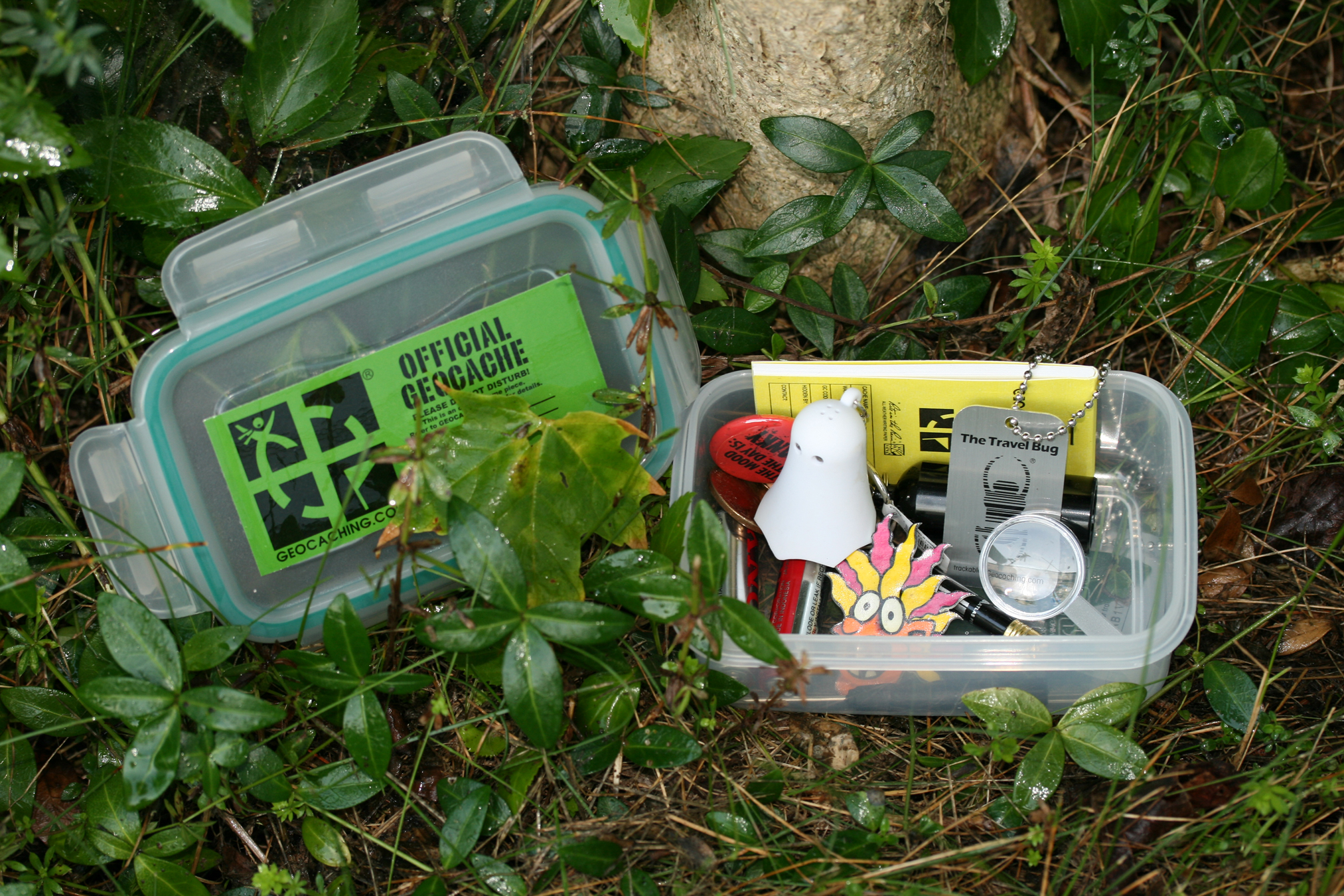
Hiding a cache with the sole expectation that dozens and even hundreds of fellow geocachers will then find it in the months and years to come may be daunting in its own right but there is also an element of secrecy which is expected as a primary code of conduct while searching for or accessing a cache site. Geocachers are strongly encouraged to use stealth when others are nearby. People not already involved in geocaching are typically referred to as “muggles” and it is important that the finding of a site does not catch the interest of a muggle. Many sites have been damaged or even removed completely by curious muggles.

Caches come in all shapes and sizes although Tupperware containers, ammo canisters and pill bottles are often used. The containers are typically camouflaged to make them more difficult to spot. General size categories include micro, small, medium and large. One large cache in Riverton consisting of a five gallon bucket with a water-tight lid currently sits under a large fake rock in the front yard of an avid geocachers. Like most caches, this one included a huge selection of toys and other trade-goods which the finder may plunder. I took a cool t-shirt for my son and left several new cars and toys. You never know what you may find. Typical items, referred to as SWAG, include toy cars, marbles, silly-bands, filled punch cards to local fast food or convenience stores as well as coins and paper money. This is usually in the form of small bills or coins and foreign currency is often found as well. In nearly every cache a log book or a least a slip of paper will be included as a means of documenting your discovery and creative team names are often used when signing. My name is dnut6 and I have gone geocaching with the red clan and nutnat as well as others. Some well-known geocachers in this area are BlueRajah, underdoggie, Sneaky McSneakerson and Scarbelly79. There is also a jargon or lingo that is specific to this activity. Often because of the small size of many of the logs, phrases such as “signed log” or “thanks for the cache” simply become “SL” and “TFTC” respectively. “DNF” stands for “did not find” which is also hard for a geocacher to admit. Bragging rights also exist for those who are “FTF” or “first to find” a newly placed cache. Logging your activities has become remarkably simple through the use of smartphones and the geocaching app. In addition to signing the physical log held in the cache itself, you can also sign the electronic log and this is where the lingo is used most often.
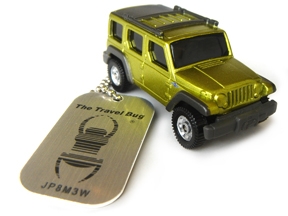
For the geocacher who is interested in participating in something beyond the stickers and toys, a travel bug can be quite exciting. Travel bugs are typically a dog-tag type marker attached to a toy car or other trinket and the tag has a number on it. By looking at that number on the geocaching app, you can trace the course of the travel bug as it travels from one state to another and even across seas to other countries. Sometimes a travel bug may even be placed with instructions to help it on its way to Scotland or some other exotic place. Each time it is moved, the travel bugs movements are logged and then the owner can even receive an alert once the travel bug has reached the intended location (Ingle).
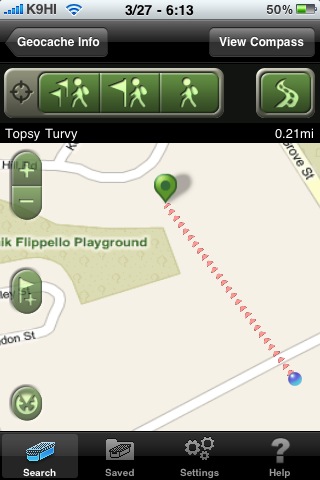
Most GPS units and smartphones have an accuracy rating to approximately 16 feet which means that your device will get you into the general area but then the searching is up to you. The creativity used by the cache owner when they chose that location is limitless. Often the cache can be hidden in plain sight. Any small crack or crevice may be used. Rock walls are favorite hiding places where the container may be tucked in or underneath the stonework. Some containers are even magnetic and may be found attached to the back of a sign or lamppost. One of my favorites was a container which the owner had wrapped with bark and then placed in the crook of the braches, causing it to look like part of the tree. The app also provides clues as well as the opportunity to read recent posts in case you find yourself struggling to find the cache (Halai).
One thing I really love about geocaching is the “alternate universe” quality it has due to the hiding places being often found in plain sight and in common everyday locations travelled by many but known by few. My kids and I get a huge kick out of driving past a previously found cache and pointing out that a geocache is right there and it is like we are the only ones who know about it. It has been a great experience for us to enjoy together and it has helped us to create a bond in a whole new way.
Works Cited
Derene, Glenn. “Geocaching” Popular Mechanics. May 2011, Vol. 188 Issue 5, p144-147 EBSCO Host. Web. 14 July 2013
Halai, Sameer. “Urban Geocaching: Treasure Right Under Your Nose” Odyssey. Jan 2008, Vol. 17 Issue 1, p37-40 EBSCO Host. Web. 14 July 2013
Ingle, Natalie. “Coordinated Efforts” Indianapolis Monthly. August 2006, Vol. 29 Issue 14, p68- 74 EBSCO Host. Web. 14 July 2013
